

You're not losing leads because the leads are bad. You're losing them because a buyer who filled out a Zillow form at 9 p.m. got your callback two days later, and by then they'd already toured a house with the agent who texted back in three minutes. The lead was fine. The lag killed it.
That gap is the most expensive problem in your pipeline, and it's also the most fixable. Below is the research on real estate lead response time, what slow follow-up actually costs you, and the exact automation we install so a new lead gets a real reply in under a minute, day or night, without you watching your phone.
Key Takeaways
- A new online lead is up to 21x easier to qualify at 5 minutes than at 30 (Source: MIT/InsideSales Lead Response Study, Dr. James Oldroyd).
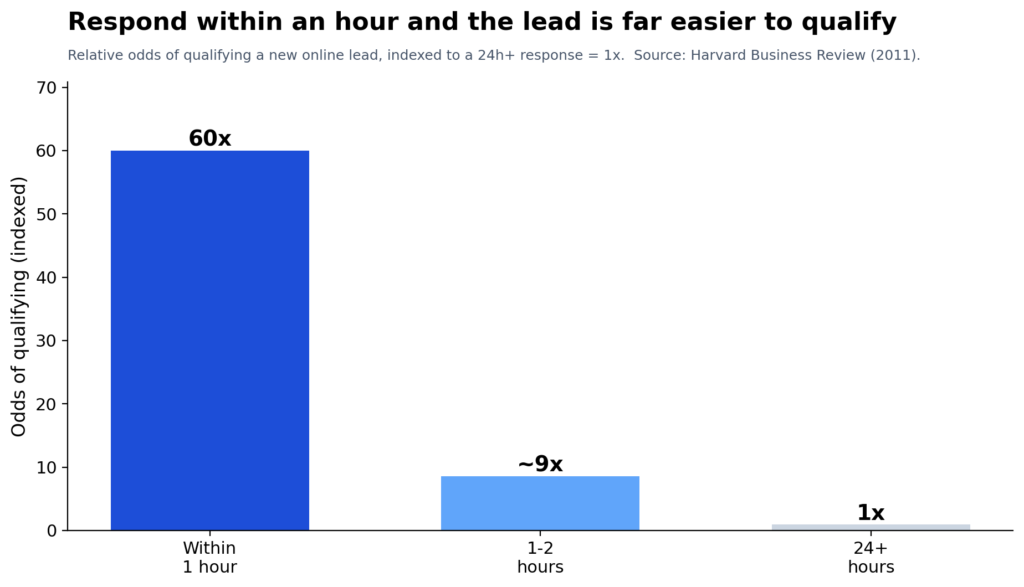
- Contact a prospect within an hour and you're about 7x more likely to qualify them than firms that waited one hour longer — and 60x more likely than those who waited a full day (Source: Harvard Business Review, 2011).
- Most agents lose leads to lag, not lead quality. Buyers tend to hire whoever answers first.
- The average online real estate lead costs roughly $180 — money you forfeit the moment a slow callback hands that buyer to a competitor.
- Instant SMS plus AI qualifying and auto-booking closes the gap, and a free speed-to-lead audit shows you exactly where yours is leaking.

How fast should you respond to a new real estate lead?
Within five minutes. An online lead is about 21x more likely to qualify at five minutes than at 30, and roughly 100x more likely to even reach the person at five minutes versus a half hour (Source: MIT/InsideSales Lead Response Study). That study analyzed about 15,000 leads and over 100,000 call attempts. The five-minute rule isn't new, but buyer behavior hasn't changed: people who just raised their hand want an answer now.
Harvard Business Review put hard numbers on the cliff. Firms that contacted a prospect within an hour were nearly 7x more likely to qualify the lead than firms that waited just one hour longer, and 60x more likely than those who waited 24 hours or more (Source: Harvard Business Review, "The Short Life of Online Sales Leads," 2011). A companion dataset of 1.25 million leads across 42 companies showed the same collapse. These are older studies, but they remain the canonical reference for how online leads behave.
Here's what that means at your desk. A buyer doesn't sit by the phone for two days hoping you'll call. They submit on Zillow, then Realtor.com, then a brokerage site, and the first agent who responds gets the showing. When a lead "ghosts" you, they hired someone faster, and your callback goes to a buyer who'd already moved on.
Why slow follow-up happens (it isn't laziness)
The gap is structural, not a discipline problem. You're a human with one phone, and leads arrive while you're showing a house, mid-closing, on another call, or asleep. Manual follow-up loses to whoever's phone buzzes first, and most of the time that buzz comes at a moment you physically can't answer. No amount of "I'll be more responsive" beats a system that replies in 30 seconds.
Look at when leads actually come in. Buyers browse listings at night and on weekends. Your manual callbacks happen 9 to 5 on weekdays. That mismatch alone leaks a chunk of every lead source you pay for. A Saturday-night inquiry that waits until Monday morning is, for practical purposes, already gone.
Then there's the CRM pile. New leads land in a tab you'll "get to later," and later keeps getting pushed. A widely cited real-estate mystery-shop from 2014 found nearly half of online inquiries got no response at all, with an average response time around 15 hours (Source: WAV Group Agent Responsiveness Study, 2014). That study is over a decade old, so treat the exact figure as illustrative, but the pattern holds in every agent's inbox we audit. Leads don't get ignored on purpose. They get buried.
What slow follow-up actually costs you
Every lead you let cool is money you already spent, handed to a competitor. The average online real estate lead runs roughly $180, climbing toward $220 in larger metros (Source: Zillow Premier Agent pricing, reported via List With Clever, 2025). When a slow callback loses that buyer, you didn't just lose a possible commission, you paid $180 to warm up a lead for the agent who answered first.
Do the math on your own pipeline. Take your monthly lead spend, then estimate the share you never reach inside the first hour. That number is the floor of what's leaking — before you count the commission on a buyer-side deal, which can run into five figures on a single closing.
The cost compounds past the lost deal. A buyer who closes with you refers their coworker, sends you their sister's listing, and leaves the review that wins the next three leads. Lose them at first contact and you lose that whole downstream chain. Slow follow-up doesn't cost you one buyer. It costs you the network that buyer would have introduced.
The fix: speed-to-lead, automated
The win isn't "try harder." It's responding instantly without touching your phone, then stepping in only when a real conversation is ready. Here's the workflow we install for agents, in the order it fires.
An instant SMS goes out in under 60 seconds. The moment a lead submits a form, the system texts them by name with a real reply, not a "thanks, we'll be in touch" auto-responder. Text beats a missed call to voicemail because people open texts and ignore unknown calls. The buyer gets an answer while they're still on the listing page, which is the entire game.
AI qualifies and books the appointment. The conversation continues over text: timeline, budget, pre-approval status, the neighborhoods they're watching. When the lead is warm, the system drops a calendar link and books straight into your schedule. You wake up to a confirmed showing instead of a missed-call notification. If you want to see how this connects to your existing CRM and lead sources, our AI lead-gen and nurturing service is built around exactly this sequence.
You take the handoff at the right moment. You're not chasing cold form-fills anymore. You're talking to people who already answered the qualifying questions and picked a time. That's a better use of your day and a far higher close rate per conversation.
Here's how one Tuesday-night inquiry runs, start to finish, from the operator's chair:
- 9:48 p.m. — A buyer named Marcus fills out a Zillow form. You're asleep.
- 9:48 p.m. — The auto-SMS fires the same minute the form lands: "Hi Marcus, this is Dana's team about the place on Linden Ave — still looking, or already under contract on something?"
- 9:51 p.m. — Marcus texts back that he's still looking. The AI asks three things across the next few messages: timeline, price range, and whether he's talked to a lender.
- 9:56 p.m. — He's moving in 60 days, sitting around $420K, pre-approved through his credit union.
- 9:58 p.m. — The AI offers two showing windows and sends a calendar link. Marcus books 10:30 a.m. Wednesday.
- 7:10 a.m. — You open your phone to a confirmed showing and a four-line summary: name, budget, timeline, pre-approval status, and the listing he asked about.
Marcus never felt processed. He got a fast, specific answer at the moment he cared, and you walk into the showing already knowing his numbers, context you'd normally spend two phone calls digging out. The agent did nothing at 9:48 p.m. and still beat every competitor who'd reply later.
This is also where most agents get AI wrong. NAR's 2025 Technology Survey found that 20% of Realtors use AI tools daily while 32% haven't adopted AI at all — and of those who use it, 46% point it at content like listing descriptions and social posts (Source: National Association of REALTORS®, 2025 Technology Survey). Only 17% report a significantly positive business impact while 46% saw no noticeable impact. The reason is simple: they're using AI to write captions, not to answer leads in 30 seconds. The biggest revenue lever,instant lead response, sits untouched. Point the automation at follow-up instead of content, and the impact shows up where it pays.
What to measure once it's running
Track three numbers and you'll know whether the system is working without any guesswork. They come straight out of your CRM timestamps, so you can check them weekly.
Median first-response time. Not your average, which one slow Sunday can wreck. The median tells you what a typical lead actually experiences. The target is under five minutes; with automation it should read in seconds. Percent of leads contacted inside five minutes is the number, aim for the high 90s, because every lead below that line is one a faster agent can poach.
After-hours coverage. Pull the share of inquiries that arrive between 6 p.m. and 8 a.m. and on weekends, then check how many got a same-minute reply. Manual follow-up usually scores near zero there. That gap is where the night-time Zillow forms quietly bleed out, and it's the first thing a speed-to-lead audit measures. Watch these three over a month and you'll see booked showings track them upward.
FAQ
How fast should a real estate agent respond to a new online lead?
Within five minutes. Qualification odds fall sharply after that window because a lead is roughly 21x easier to qualify at 5 minutes than at 30 (Source: MIT/InsideSales Study). Hitting "instant" by hand is unrealistic when you're showing homes, so automation is what makes a sub-minute reply actually happen.
Why do my online real estate leads never respond?
Usually they did respond, to a faster agent. A buyer submits on several sites at once, and slow first contact reads as "nobody's home." By the time your callback lands, they've already booked a showing with whoever texted back first. The lead wasn't dead; it cooled while it waited.
Is texting or calling better for first contact with a lead?
Lead with a text inside the first minute, then call. People open SMS and screen calls from unknown numbers, so an instant text gets read while a missed call goes to voicemail. The text opens the conversation and earns you permission for the call that follows.
Can AI follow up with real estate leads without sounding robotic?
Yes, for the first touch — qualifying and booking. The AI handles the timeline-budget-pre-approval questions over text and hands you a screened buyer who's picked a time. You step in for the human part of the relationship. The point isn't to replace you; it's to buy you speed and warm conversations.
How much business am I losing to slow follow-up?
Multiply your monthly lead spend by the share you never reach inside the first hour. At roughly $180 a lead, the leak adds up fast, and that's before the commission on any buyer who closes. A speed-to-lead audit measures yours against the timestamps in your own CRM.
Get a free speed-to-lead audit
If new leads are cooling before you reach them, the fix is mechanical, not motivational. We'll review your current response times against your CRM data, show you where leads are leaking, and map the instant-SMS-to-booked-appointment workflow for your lead sources. Book a free speed-to-lead audit and we'll tell you exactly what it's costing you, and what it takes to close the gap.